

Financial institutions are under simultaneous pressure: competing financial institutions, fintechs without branch overhead, megabanks with nine figure technology budgets, and a generation of users who will leave for a better app without a second thought. Until now, the digital banking platform has typically been evaluated as an operating expense—a way to reduce cost, improve user satisfaction scores, and check a modernization box.
An independent study by 451 Research / S&P Global Market Intelligence changes that calculus. Lumin Digital’s platform doesn’t just reduce cost. It accelerates enterprise value and here is the proof.
About the S&P Global Intelligence Report
This is not a case study. This report is a composite financial model built from real deployment data across Lumin Digital clients ranging from $490M to $9.1B in assets, risk-adjusted and validated by S&P Global analysts. After five years on Lumin’s Compounding Growth Platform, the composite financial institution realized the following results, but the real story isn’t the total. It’s how that value compounds over time.
$12.8M
cumulative total
financial impact
$8.8M
net present value (NPV)
145%
discounted ROI over five years (91% within the first three years)
~11-month
payback period
The compounding curve
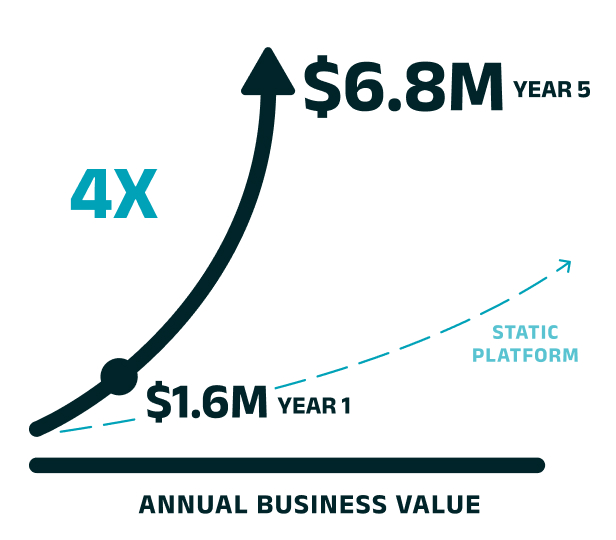
The composite organization recognized $1.6M in annual business value in Year 1. By Year 5, that figure had grown to $6.8M annually—a 4x increase. Cumulative business value reached $20.8M by Year 5. This is not a one-time modernization benefit that plateaus after go-live. It is a compounding growth trajectory.
The ROI accelerates precisely because a Compounding Growth Platform builds on itself: user data deepens, relationships expand, and digital primacy compounds across the full lifecycle. Assembled platforms with integration seams and siloed intelligence cannot replicate this curve.
The institutions on Lumin’s platform aren’t maintaining pace with their competition. They are opening a gap that widens every year.
S&P Global Market Intelligence, Technology Impact on Business Report.
Based on a composite of Lumin Digital client deployments.
By year five, 75% of total value is driven by top-line revenue growth
The value mix shifts materially over time. In Year 1, operational efficiency gains represent a larger share of total value. By Year 5, approximately 75% of total financial value is driven by revenue expansion, with efficiency gains making up the remaining 25%:
Net interest income (NII) from loan and deposit relationships
Retained revenue from users who stay
Interchange revenue from higher card engagement
This is the compounding mechanism in practice: efficiency gains arrive early, while revenue benefits—NII uplift, interchange, retained user value—build and accelerate as digital primacy deepens across the user lifecycle.
By year 5, NII uplift alone represents nearly half of the total annual business value.
Operational efficiency that scales with growth
Reliability as a financial variable
Downtime is not just an IT issue. It is revenue disruption, productivity loss, regulatory exposure, and reputational risk, and it compounds silently against institutions still running on outdated or cobbled-together architectures. Study participants reported:
95% reduction in annual downtime (from 18 hours to 1 hour annually)
Significant reductions in outage frequency and duration from year 1
Faster recovery enabled by cloud-native, microservices architecture
The cloud-native foundation also creates the structural precondition for everything else: weekly releases with zero downtime, 99.99% platform uptime, and an AI-driven transformation that embeds intelligence across the full platform through 2026 and beyond because a system that never stops improves continuously.
What this means for your institution
The institutions that are breaking away from their competition right now share a common profile. Their active digital user rates climb month over month. Their commercial accounts grow. Their NPS scores are at all-time highs. Their boards no longer question the technology expense, because it is proven to be an investment.
The S&P Global Market Intelligence study is the first independent, third-party-validated composite financial-impact study published in this market.
The outcome is clear: Lumin’s Compounding Growth Platform multiplies enterprise value.