

Shadow AI is already inside of your institution. It is in the tools that your employees are using without approval, in the apps your users are connecting their accounts to without your knowledge, and in the decisions being made with your data outside of any governance you can control. This is not a future risk. It is the current state.
Every day without a governed AI strategy is a day that trust is being transferred away from you. Not dramatically. Not all at once. Quietly, transaction by transaction, interaction by interaction, until the relationship your institution spent decades building is being intermediated by tools you never sanctioned and cannot see.
The market is at peak AI hype and peak AI anxiety simultaneously. Most institutions are somewhere in between – aware they need to move, unsure what they can actually defend.

Most banking AI is shadow AI, layered on top, connected loosely, governed reluctantly. The institutions that win the AI era won’t be the fastest deployers. They’ll be the ones whose AI was embedded in a system with clean data, clear accountability, and architecture built to compound intelligence rather than accumulate it.
TYLER ANTICEVICH
Senior Product Manager, Lumin Digital
The cost of getting this wrong is not hypothetical. It is reputational exposure, regulatory, and financial. Every AI tool added without governance creates a new audit surface. Every unauthorized data handoff is a breach waiting for a condition.
The FFIEC revised its model risk management guidance in April 2026, and explicitly carved out generative and agentic AI. There is currently no clear regulatory framework for the AI features vendors are shipping today. Examiners are asking the question anyway.
A Pennsylvania community bank disclosed a material breach caused by an employee feeding user data into an unauthorized AI tool. The Pennsylvania breach wasn’t a policy failure. It was an architecture failure. Shadow AI doesn’t happen because employees are reckless – it happens because the platform didn’t give them a governed path. The ABA have even testified before Congress that generative AI is industrializing scams.
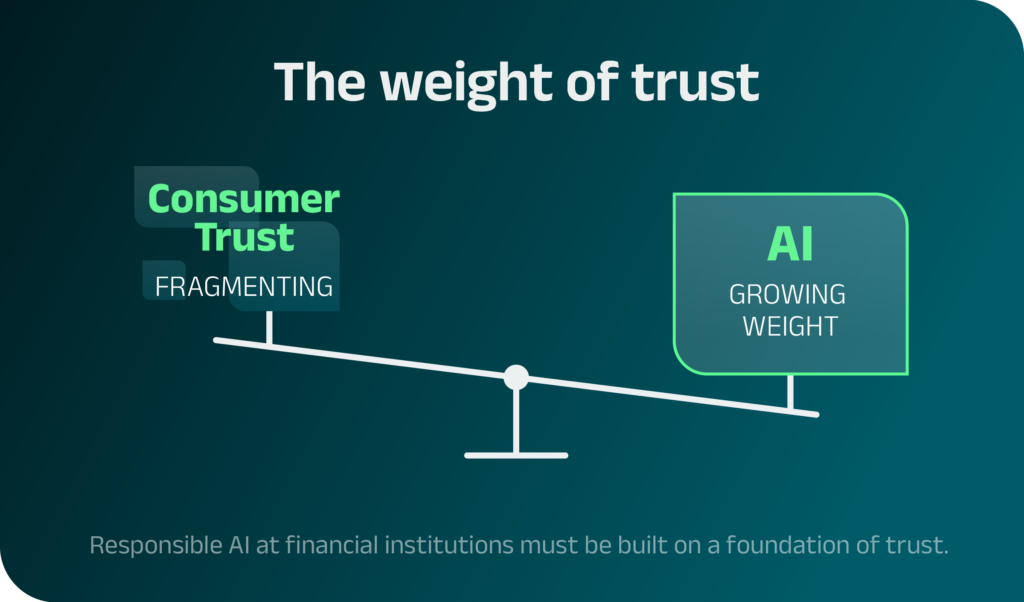
Your consumers want convenience and control
“My data could be misused” is now the number-one concern about AI in banking, and it’s still climbing, to roughly 52% according to over two years of Lumin’s AI research across hundreds of digital banking users. Strong resistance to sharing data with AI grew sharply as well.
The relationship between a financial institution and its consumers has always been built on one thing above everything else: trust. AI is putting that foundation under pressure in ways that are no longer theoretical.
Shadow AI has already infiltrated the workflows of financial institutions, employees, and users, void of any governance or oversight. The Pennsylvania bank breach made the consequences concrete and public. The stakes have never been higher, and the window for reactive responses has closed. Financial institutions need governed AI resources for their teams now, delivered through partners who don’t just understand the risks but are laying the foundation. The time for evaluating AI governance is over. Modular, embedded AI closes that gap by design.
Increased familiarity with AI is sharpening consumer skepticism of AI within their banking experience. The research shows an understanding of AI well climbed from 23% to 31% in 2026, and regular use of tools like ChatGPT and Gemini nearly doubled, to 23%.
The better people understand these tools, the more protective of their information they’ve become. These aren’t uninformed users afraid of something new. These are increasingly informed users who’ve decided what they’re not willing to accept.
The use cases for AI are broad and ever growing. Fraud detection, personalization, and financial wellness are all examples of how AI will improve user experience. Alternatively, comfortability and demand for AI by users is still plagued by concern.
Trust built inside your walls will expand to your community
The trust between a financial institution and its consumers is one of the most hard-earned relationships in business; a requirement that maps directly to what regulators are beginning to demand – explainability, human approval, and clear accountability for every AI action.
Institutions that invest in transparency, session-level protection, and human-confirmed execution are going to take the lead, enabling a one-of-a-kind intelligence relationship that compounds. One where users feel safer over time and that carries over to the communities they serve. This matters because the instinct in most AI conversations is to move faster and add more features, more automation, and more surface area.
Banking in the AI era is about understanding, not speed
Shadow AI has already changed the terms of accountability. When employees use ungoverned tools and users connect unauthorized apps to their accounts, the audit trail becomes one you didn’t write and cannot control. Examiners are asking a new question, “Can you explain, in plain language, how your AI models make decisions?” The examiner’s question reflects the current reality.
The regulatory gap between what vendors are shipping and what guidance currently covers can vary depending on your institution’s architecture.
Every month you run ungoverned AI is another month of audit exposure, breach surface, and user trust eroding in ways that won’t show up in engagement metrics until it’s already costly. The question to now ask is how far behind is your institution today, and how do you stop it?
Lumin Solaire is forging the path forward
Lumin’s approach to AI, Lumin Solaire, is an embedded intelligence layer that’s built into the architecture from the ground up rather than retrofitted on top.
This Lumin philosophy extends to what users are asking for when they say they want AI they can trust, and what institutions are responsible for when they put their name behind it.
Trust is not a feature. It cannot be added after the fact. An AI strategy starts from the premise that trust has to be earned at the architecture level before a single feature ships.
Responsibility and ethics

Opt-in at every level
Institutions choose which AI capabilities to enable. Their users can be asked for explicit consent before any AI interaction. No one is opted in by surprise, and AI is never invisible: users can see when it’s involved. When data misuse is the number-one concern in the market and still climbing, transparency isn’t a courtesy. It’s the minimum.

Additive, never subtractive
AI layers onto existing workflows without removing the manual path. Anyone who prefers not to use AI (and that’s a meaningful, vocal share of users), keeps every bit of functionality they have today. AI earns its place by helping. Not by eliminating the alternative.

Humans in the loop
AI accelerates the work. A person stays responsible for completing every action. The system can surface an option, model an outcome, or prepare a draft. A human reviews it and decides. The work moves faster without ever moving out of human hands. That’s not a constraint on what AI can do. It’s the architecture of earned trust.

Assistive, not decisioning
AI informs and accelerates, it does not make decisions or act on its own. No lending decisions. No credit determinations. No autonomous movement of money. Comfort with AI making financial recommendations has stayed flat for a year, split roughly down the middle. The AI recommends. People decide.
Safety and security

Enterprise-grade security, no exceptions
AI is held to the same security and compliance controls as the rest of the platform, not a lighter standard because it happens to be new. And because AI is non-deterministic, no feature is ever treated as finished. Each one stays under continuous review and is threat-modeled by our security team.

Foundational and modular
AI is a first-class citizen in the platform architecture, delivered as a modular, API-driven service, not a siloed bolt-on, held together by a contract no one in the chain can fully account for. That’s the exact setup behind the shadow AI incidents now making headlines. Being modular also means it falls back to the underlying non-AI workflow if the AI path is ever unavailable. Resilience isn’t an afterthought.

Centrally controlled and audited
AI runs through a central orchestration layer inside each institution’s own single-tenant environment. What’s asked of the AI and what it returns can be audited at the level of each individual request. That’s what turns “trust us” into something an institution and its examiner can actually verify.

Data stays private
We send the AI only the data a given task requires. Sensitive data isn’t sent without explicit approval. Inputs and outputs are never used to train underlying models and are never shared with model providers. Everything runs encrypted, inside that same isolated environment. When data misuse is users’ primary concern, this isn’t a differentiator. It’s a precondition for being in the conversation at all.
Get this right today and you will not have to rebuild trust tomorrow
Shadow AI does not announce itself. It accumulates quietly, one approved exception at a time, until the exposure is too significant to ignore and the remediation costs more than the capability ever delivered.
The path forward is not complicated, but it does require a decision. AI that earns trust is AI that was built to earn it, governed from the architecture up, transparent to users, auditable by examiners, and accountable at every layer of the data chain. That is the minimum viable standard.

Tyler Anticevich
Senior Product Manager, Lumin Digital

Byron Tatman
Principal Product Manager, Lumin Digital
1. Model risk management guidance — Model Risk Management: Revised Guidance, OCC Bulletin 2026-13 (OCC, Federal Reserve, and FDIC), April 17, 2026.
2. Shadow-AI breach — “A bank breaks its silence on its shadow-AI breach,” American Banker, June 2026; Community Bank / CB Financial Form 8-K filed with the SEC, May 2026.
3. AI-enabled fraud — Testimony of Paul Benda (EVP, Risk, Fraud & Cybersecurity, American Bankers Association) before the U.S. Senate Special Committee on Aging, July 2026.
4. Consumer sentiment figures — Lumin Digital AI in Digital Banking consumer survey, Round 2 (U.S. digital banking users; fielded March 2026, compared year over year with the 2025 wave).